
Cycling Knows What Is Broken. Now Comes the Hard Part.

Updated: 7 days ago
Inside the UCI’s “Future of Cycling” report — and why its proposals on media rights, team finances, fan engagement and competitive balance connect almost every major economic debate in professional cycling.
Professional cycling has rarely lacked audiences, stories or commercial visibility. According to the UCI’s 2026 Future of Cycling report, professional road cycling represents around €850 million in annual team budgets, employs 1,864 people within professional teams, generates more than 123,000 hours of WorldTour and Women’s WorldTour broadcasting, reaches more than 145 countries and produces a cumulative television audience of around 3 billion. The Tour de France alone attracts more than 10 million roadside spectators each year. By almost any measure, this is a sizeable global sports product. Fichier markdown(1).md collé
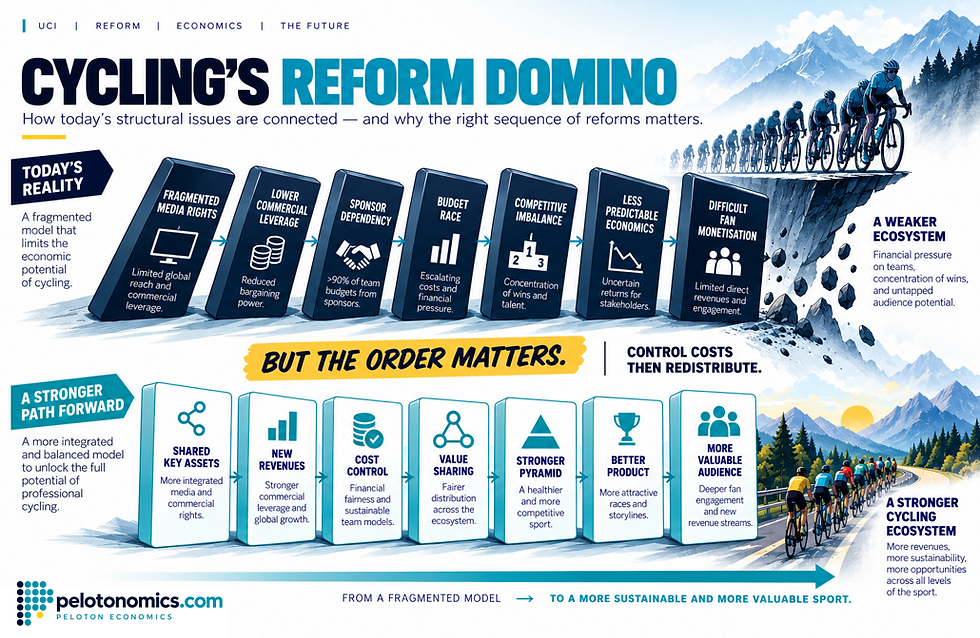
And yet the economics underneath it remain surprisingly fragile. Teams still typically derive more than 90% of their budgets from title and secondary sponsors, organisers report costs rising faster than revenues, commercial rights remain fragmented and the relationship between millions of spectators and direct revenue remains weak. Fichier markdown(1).md collé That contradiction is what makes the UCI report interesting from a Pelotonomics perspective. Its significance is not that it has suddenly discovered problems nobody knew existed. It is that, after receiving contributions from across cycling’s ecosystem, many of the structural issues examined separately in previous Pelotonomics analyses now appear together in a single reform discussion. Sponsorship dependency, team inequality, organiser power, fragmented commercial rights and the failure to turn fans into customers are no longer separate conversations. They increasingly look like different consequences of the same economic architecture.

1. A consultation that says more than a reform plan
The UCI consultation is important to read correctly. It is not a final reform blueprint, and the proposals collected in the report should not automatically be interpreted as UCI policy. The process launched in February 2026 was organised around five pillars — Calendar & Participation, Economic Model, Fan Engagement, Safety and Integrity of Results — and the report synthesises ideas submitted by the sport’s different stakeholder families. Fichier markdown(1).md collé In other words, what matters at this stage is less whether every proposal will become a regulation than what the collection of proposals tells us about where the industry believes its structural weaknesses lie.
And the convergence is striking. 80% of contributors addressed the event calendar, 76% competition formats, 65% the race/team pyramid and participation rules, 56% commercial rights, 53% new rights and value sharing and 51% financial rules. Digital platforms, television production, solidarity mechanisms, transfers and technology recur throughout the document. Fichier markdown(1).md collé At the end of the report, the UCI distils the consultation into nine recurring directions, ranging from a geographically more coherent calendar and stronger second division to consolidated commercial rights, financial fairness, modernised broadcasting and more structured transfer rules.
This matters because professional cycling has tried structural reform before. The challenge has rarely been a shortage of ideas; it has been creating sufficient alignment between actors whose economic interests are fundamentally different. Race organisers own valuable events and historical rights. Teams create much of the recurring sporting narrative but own relatively few durable assets. Riders create sporting and increasingly media value, while sponsors finance much of the system without controlling it. The UCI regulates an ecosystem whose most valuable properties are often controlled by others. The consultation therefore reveals something more important than a list of reforms: cycling appears increasingly aligned on the diagnosis, while remaining much less aligned on ownership of the solution.
2. The €850 million paradox
The report’s most revealing number may be €850 million. That is the combined 2025 budget of the professional teams covered by the UCI’s figure. Fichier markdown(1).md collé It sounds large — and it is. But it also illustrates an unusual characteristic of cycling. Hundreds of millions are spent every year on sporting performance, yet comparatively little of that expenditure is financed by revenues generated directly by the teams themselves.
This is the paradox explored in Pelotonomics’ “The Name on the Jersey.” Professional cycling has built an extraordinarily effective sponsorship platform, but sponsorship has become both its engine and its structural vulnerability. A football club can lose a shirt sponsor and still retain broadcasting income, ticketing, stadium revenues, merchandising and a transferable sporting asset. A cycling team losing its title sponsor can lose not only a major source of income but effectively the economic foundation on which the organisation exists. The UCI consultation reaches essentially the same diagnosis: teams typically rely on title and secondary sponsors for more than 90% of their budgets.
The second problem is distribution. As explored in “The Growing Gap in Pro Cycling,” additional money does not automatically produce a healthier sport if it concentrates disproportionately among the richest organisations. More resources attract better riders, deeper support structures, better technology and greater ability to accumulate UCI points and victories. Sporting success then strengthens sponsorship value and attracts still more resources. The UCI report consequently identifies a budget cap or equivalent financial-fairness mechanism as the single most frequently referenced regulatory measure, with variants including salary caps, points caps, soft caps and luxury-tax mechanisms.

The underlying issue is therefore not whether professional cycling has money. It is what kind of money it has. €850 million of expenditure does not necessarily mean €850 million of durable enterprise value. A business financed predominantly by annually renegotiated sponsorship contracts is fundamentally different from one supported by recurring media rights, direct consumer revenues, intellectual property and long-term commercial assets.
3. The real revolution would be pooling the product
This leads to perhaps the most consequential section of the UCI report. Contributors propose consolidating parts of cycling’s commercial and media rights into a more unified offer — potentially an “official global circuit” capable of being marketed collectively to broadcasters and global sponsors. Alongside it could sit a central digital platform capable of creating new assets around race data, content, sponsorship and direct fan engagement.
That proposal goes directly to the question explored in Pelotonomics’ “The Power of Race Organisers.” Cycling is not one product owned by one league. ASO, RCS Sport, Flanders Classics and many other organisers control individual race properties with their own media, hospitality, sponsorship and territorial economics. The biggest races are valuable precisely because their owners have spent decades building those assets. Unsurprisingly, organisers participating in the consultation insist that historic commercial rights and the operational risks they carry must be respected. The report summarises the principle neatly as “growth through common assets, not predation”: collaboration should create incremental value rather than merely redistribute somebody else’s existing revenue.
This also explains why the debate resembles the one behind “The Fight to Reinvent Pro Cycling: Inside the Collective Cycling Group.” Teams have long argued that they generate a substantial share of cycling’s recurring entertainment value without controlling enough of the underlying commercial product. The UCI consultation does not resolve that tension, but it potentially changes its scale. It discusses a unified redistribution pool drawing on central sponsorship, hospitality, data licensing and part of media revenues; a centralised digital platform; and even potential centralisation of WorldTour media rights through a commercial vehicle. If any meaningful version of that architecture emerged, professional cycling would move incrementally from a collection of independently monetised events towards something closer to a jointly commercialised sports ecosystem.

And that changes the central economic question. It is no longer simply “How can cycling generate more revenue?” It becomes: who owns the assets that generate that new revenue, who controls the commercial vehicle, and according to what logic is the resulting value distributed?
4. More revenue will not fix cycling if costs simply follow it
There is an unusually important sentence running through the economic section of the report: cost discipline should precede redistribution. Organisers warn that injecting permanent new revenues into a system without controlling its cost dynamics could simply finance the next round of budget inflation. The UCI explicitly says it shares that sequencing concern.
Economically, the logic is compelling. Imagine that centralised rights eventually created an additional €100 million for the professional ecosystem. If teams immediately converted most of that into higher salaries, larger performance departments and more expensive competitive programmes, cycling would be richer without necessarily becoming more sustainable. The absolute budgets would rise, but the underlying arms race could remain intact. The gap between organisations could even expand if new revenues were distributed unevenly or if wealthier teams retained greater capacity to supplement shared income with private sponsorship.
That is why the report’s different proposals need to be viewed as a system rather than a menu. Financial fairness, solidarity mechanisms, new revenue, redistribution and competitive balance are economically interdependent. It is also why some of the more radical proposals deserve attention. Contributors suggest making a WorldTour licence a regulated transferable asset, reforming transfer markets with fees and training compensation, mutualising certain broadcast and safety costs and creating a UCI-governed solidarity fund financed by new revenue streams. These are stakeholder proposals rather than adopted rules, but they point toward a fundamentally different idea of what a cycling team could eventually become.
That question also connects to “The Team Built Backwards.” Unibet Rose Rockets is interesting not merely because of its content strategy, but because it attempts to create value around a team that extends beyond a sponsor cheque: audience, identity, community, media and a persistent brand. The logical end point of the UCI’s economic debate is similar. Can a professional cycling team become a durable economic asset rather than an organisation whose value largely resets with each sponsorship cycle?
5. Cycling does not only need spectators. It needs customers.
The fan-engagement section may ultimately prove just as important as media-rights reform. The report describes cycling as having a large but passive audience, notes that its commercial value lags behind the size of that audience and identifies under-35s as under-represented. Contributors call for onboard cameras, live power and telemetry, GPS overlays, drones, team radio, athlete-led storytelling, behind-the-scenes content and a central digital platform offering shared data, archives, live tracking and potentially premium content.
This goes directly to the thesis of Pelotonomics’ “Can Fans Become Pro Cycling’s Next Revenue Stream?” Cycling has traditionally been exceptionally good at generating reach while remaining surprisingly weak at identifying and monetising the people behind that reach. A roadside spectator is economically valuable to a host city, a television viewer to a broadcaster and an audience aggregate to a sponsor — but the sport itself often knows almost nothing about that individual. There is usually no account, no transaction, no direct relationship and therefore little lifetime customer value.
A central digital ecosystem could alter that equation. The commercial prize is not simply another streaming service. It is the possibility of moving from anonymous attention to an identifiable relationship: viewer → registered fan → engaged user → member → merchandise buyer → premium-content subscriber → event participant. Permanent rider numbers, rider-focused merchandise and better storytelling, all raised in the consultation, become more interesting when viewed through that funnel. This is again where “The Team Built Backwards” becomes relevant: the Rockets model starts with content and community, then tries to convert audience into commercial leverage. Traditional cycling largely starts with the sporting product and hopes an audience can later be monetised around it.
The opportunity, therefore, is larger than improving television graphics. Cycling does not fundamentally have an audience problem. It has a conversion problem.
6. Even the calendar is an economic asset
At first sight, reorganising the calendar into geographical blocks sounds like a sporting or logistical issue. Economically, it is much more. Calendar and competition formats were the two subjects raised by the largest proportion of contributors — 80% and 76% respectively.
The report describes support for fewer unnecessary overlaps, clearer seasonal sequences, geographical clusters and more predictable participation.
A more coherent calendar could reduce transport and logistical costs, but its greater commercial value would be predictability. Broadcasters can market clearer narratives. Sponsors know when and where their assets will appear. Organisers can sell hospitality and partnerships with greater certainty about participating teams and leading riders. Fans can more easily understand what matters. The report even notes calls for participation confirmations to arrive earlier and for calendar dates to be established at least twelve months in advance. Calendar architecture, in other words, is part of product architecture.
This also connects back to “The Power of Race Organisers” and “The Business of Hosting the Tour.” A race is not merely a sporting date: it is simultaneously television content, a sponsorship platform, a hospitality product, a tourism asset and an investment by host cities and regions. Predictability increases the value of each of those relationships. Meanwhile, strengthening the ProSeries and ProTeam level — another recurring recommendation — matters because an economically viable second division preserves competitive mobility, race diversity and the open pyramid that differentiates cycling from closed-franchise sports.
7. The reform agenda is becoming remarkably coherent
Viewed individually, the report contains dozens of ideas. Viewed economically, however, they increasingly describe one model. Consolidate enough rights to create stronger commercial assets. Develop new revenues around media, data, digital platforms, sponsorship and fans. Introduce financial mechanisms that prevent those revenues simply fuelling another spending race. Share part of the incremental value across teams, organisers and development. Strengthen the second tier. Improve the calendar and sporting product. Use richer content and data to create a more direct relationship with fans. The nine recurring recommendations in the UCI’s conclusion broadly follow that logic.
This is what makes the report such an interesting moment for the business of cycling. Many debates previously taking place independently are beginning to converge. “The Name on the Jersey” examined sponsor dependency. “The Growing Gap in Pro Cycling” examined financial concentration. “The Power of Race Organisers” looked at where durable rights sit. “The Fight to Reinvent Pro Cycling” examined the teams’ attempt to gain greater control over the value they help create. “Can Fans Become Pro Cycling’s Next Revenue Stream?” explored the missing direct-to-consumer layer. “The Team Built Backwards” examined what happens when a team begins with audience and brand rather than sponsorship. Even “The Fleet Behind a WorldTour Team” illustrates the operational side of the same equation: professional cycling is a complex travelling business whose costs extend far beyond rider salaries.
The UCI consultation effectively places many of those pieces on the same table. The transformation it describes can be reduced to four economic shifts: fragmented rights towards shared commercial assets; sponsor dependency towards diversified recurring revenues; passive audiences towards direct fan relationships; and unrestricted budget escalation towards some form of financial fairness. None is revolutionary in isolation. Implemented together, however, they would represent a substantial change in how professional cycling creates, captures and distributes economic value.

8. The hard part is ownership
The UCI ends on an optimistic note. It sees broad common purpose in the responses and says the next stage will involve deeper collaborative consultation aimed at turning the most promising ideas into a consensual and durable model. But one detail buried in the economic discussion should temper expectations. The UCI notes that a previous Financial Fairness Working Group had already carried out an initial assessment — before the work stopped following teams’ refusal to implement it. Agreement that a problem exists is not the same as agreement on who should bear the cost of solving it.
That is the central tension running through almost every reform proposal. Teams want greater economic stability and a larger share of value. Organisers want growth without losing rights built over decades. Riders want stronger economics and opportunities without artificial constraints on careers. Sponsors want reach, engagement and measurable returns. Fans want better access and storytelling. The UCI wants a more coherent and commercially valuable sport while preserving an open ecosystem. Those objectives are not necessarily incompatible — but neither are they automatically aligned.
The most consequential questions therefore remain unanswered. Who controls a global commercial package? Who owns the fan relationship and the data behind it? Which existing media rights could realistically be pooled? How much value should flow to teams, organisers, riders and development? What happens to newly created revenues under a budget cap? And if WorldTour licences eventually become transferable assets, who ultimately captures the capital value created by reform? These are not details to resolve after the new model is designed. They are the new model.
That may ultimately be the most important conclusion from Future of Cycling. Professional cycling is not short of popularity, money, stakeholders or ideas. It is short of an economic architecture capable of connecting them efficiently. The UCI consultation suggests that much of the sport now recognises the same structural weaknesses — and, increasingly, many of the same potential solutions.
Cycling knows what is broken. The hard part is no longer identifying the solution. It is agreeing who owns it.
Sources & references
Primary source: Union Cycliste Internationale — Future of Cycling: Stakeholder Consultation on the Reform of Professional Road Cycling (2026). The report synthesises stakeholder submissions and distinguishes contributor proposals from UCI comments; proposals referenced in this article should therefore not be interpreted as adopted UCI regulations unless explicitly stated.
Pelotonomics analysis builds on the themes previously developed in The Name on the Jersey, The Growing Gap in Pro Cycling, The Power of Race Organisers, The Fight to Reinvent Pro Cycling: Inside the Collective Cycling Group, Can Fans Become Pro Cycling’s Next Revenue Stream?, The Team Built Backwards, The Business of Hosting the Tour and The Fleet Behind a WorldTour Team. Those internal links should be embedded directly on the article titles in the Wix version rather than collected only at the bottom.


Comments