
The Business of Hosting the Tour

Why cities compete — and pay — to become part of cycling’s most valuable travelling stage
Every July, the Tour de France draws a new line across the map. Some towns appear for the first time, others return again and again, while every few years the race starts hundreds — sometimes thousands — of kilometres from France.
Behind that changing geography lies a surprisingly competitive business.
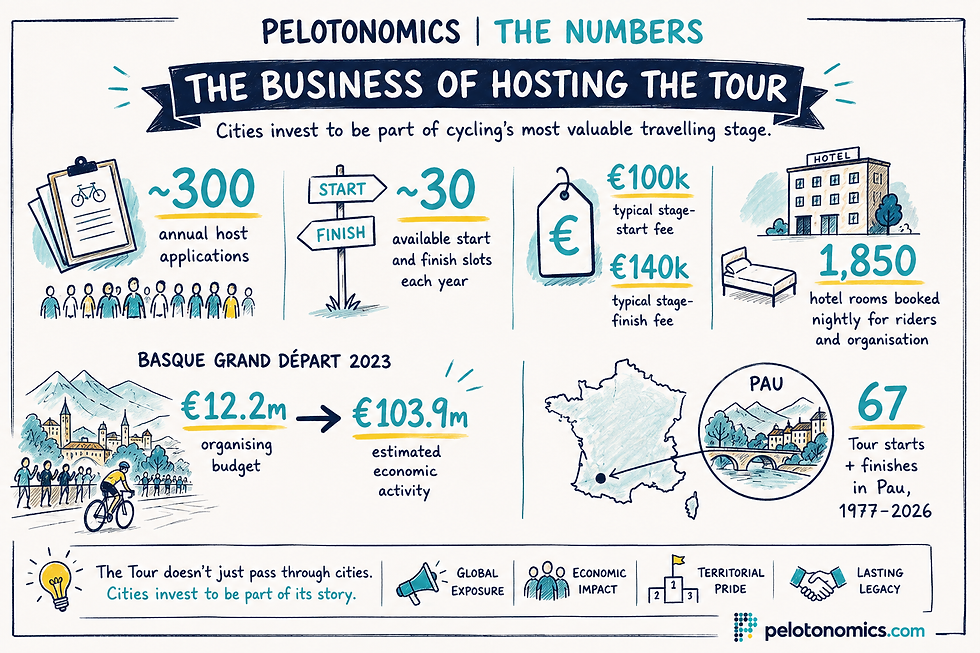
Tour director Christian Prudhomme says A.S.O. receives around 300 applications every year for roughly 30 available start and finish slots — around 250 from France and 50 from abroad.
That imbalance tells much of the story. Hosting the Tour has become a scarce asset for cities and regions willing to invest public money in exchange for spectators, tourism revenues, international television exposure and territorial branding.
The Tour is therefore much more than a cycling race passing through a city. It is a travelling media platform — and cities compete to become part of it.
Around 300 applications compete for roughly 30 Tour de France start and finish slots each year.
1. 300 candidates for 30 spots
Money alone does not buy a place on the Tour.
A.S.O. first has to build a coherent sporting route: mountains, sprint stages, time trials and transfers all need to fit together. Geography therefore immediately eliminates many potential hosts.
Then come logistics. A host city needs suitable roads, enough space for buses, trucks and technical infrastructure, accommodation capacity, security resources and good access for the enormous travelling Tour ecosystem.
And finally, there is television.
A medieval centre, a dramatic coastline, a château or a mountain panorama can strengthen a candidature because the Tour is simultaneously a sporting competition and a three-week tourism commercial for France and its neighbouring countries.
The result is a balancing act between sporting interest, operational feasibility, territorial rotation and commercial attractiveness.
A.S.O. also deliberately combines new destinations with places it knows work well. Prudhomme has explained that the organiser aims to cover France broadly over a five- or six-year period while continuing to return to established Tour territories.
That creates an interesting paradox: every Tour is presented as a new route, yet some geographical corridors remain remarkably stable.
The route changes every year, but its geography is remarkably persistent. The Alps and Pyrenees remain structural anchors, while different corridors connect them to regions that rotate in and out of the race.
2. Behind the route: politics and lobbying
With roughly ten candidates for every available slot, securing the Tour inevitably involves lobbying.
Mayors, regional presidents, tourism authorities and other elected officials regularly pitch their territories to A.S.O. Some candidatures are maintained for years before finally succeeding.
Prudhomme has even noted an increase in applications ahead of French municipal elections — a revealing indication of the political value attached to hosting the Tour.
For a local politician, the attraction is obvious. The Tour is free for roadside spectators, highly visible, overwhelmingly popular and capable of placing a relatively small town at the centre of national television coverage for several hours.
For a Grand Départ, lobbying moves to another scale.
The Basque Country's 2023 Grand Départ brought together seven public institutions, including the Basque Government, provincial councils and the cities of Bilbao, San Sebastián and Vitoria-Gasteiz.
Italy's first Grand Départ in 2024 similarly required cooperation between Florence, Emilia-Romagna and Piedmont after years of discussions.
The product being sold is therefore increasingly bigger than a city.
A Grand Départ can become a regional or even national destination-marketing campaign built around cycling.
3. How much does hosting the Tour cost?
For a normal Tour stage, the price of entry is relatively clear.
In 2025, Prudhomme put A.S.O.'s hosting fees at approximately €100,000 excluding VAT for a stage start, €140,000 for a finish and €240,000 for a city hosting both.
But the hosting fee is only part of the bill.
Cities must also finance security, road preparation, barriers, signage, cleaning, mobility plans, local communication, public events, technical infrastructure and personnel.
So there is an important distinction:
Hosting fee ≠ total hosting cost.
And Grand Départs operate on a completely different scale.
The public agreement for Italy's 2024 Grand Départ allocated approximately €7.93 million including VAT to A.S.O., shared between Emilia-Romagna, Florence and Piedmont.
Academic research into Denmark's 2022 Grand Départ estimated at least €21 million in total direct financial costs, including an A.S.O. fee of approximately €5.5 million.
Why would public authorities spend millions to host a bicycle race?
Because they are not really buying a bicycle race.
They are buying visitors, television exposure and destination marketing.
4. Does the investment pay off?
This is where the economics become particularly interesting.
The Tour itself creates an immediate travelling market. Prudhomme says approximately 1,850 hotel rooms are booked every night for riders and the organisation, representing around €230,000–€300,000 in daily accommodation expenditure before journalists, sponsors, spectators and other visitors are included.
Independent academic research provides an even more useful benchmark.
A study comparing French départements hosting Tour stages with comparable non-hosting territories found that hosting a stage generated roughly 3,400 additional visitors and 6,800 additional overnight stays, corresponding to around €0.9 million in additional tourism spending per stage. When spillovers into neighbouring territories were included, the estimate approached €1.8 million.
For Grand Départs, the numbers become much larger.
The 2023 Basque Grand Départ had an organising budget of €12.2 million. Its official economic-impact study calculated €103.9 million in additional economic activity — around 8.5 times the organising budget — as well as €58.2 million in GDP and almost €19.5 million in public revenues.
Importantly, 104 of the 113 service contracts — 92% — were awarded to Basque companies.
Hosting expenditure therefore becomes economic activity itself.
Denmark's 2022 Grand Départ attracted an estimated 1.665 million spectators across three stages, while tourism spending reached DKK757 million. The event also generated around 47,000 international editorial mentions.
These figures should nevertheless be treated carefully. Economic-impact studies use different geographical boundaries and methodologies, so a €100 million impact in one study cannot automatically be compared with €20 million in another.
The evidence supports a genuine economic effect. It does not support one universal ROI formula.

5. Where the Tour keeps coming back
If hosting the Tour were simply a tourism auction, the route would probably look very different.
History and operational efficiency matter too.
Your analysis of the last 50 editions illustrates this particularly well. Between 1977 and 2026, Pau records 67 stage starts or finishes, ahead of Paris with 53, Bordeaux with 34, Alpe d'Huez and Morzine with 33 each, and Saint-Étienne with 31.
These recurring hosts are not random.
Pau is a natural gateway to multiple Pyrenean routes. Bourg-d'Oisans and Alpe d'Huez sit at the heart of cycling's most recognisable Alpine landscape. Morzine combines mountain roads with substantial tourism and accommodation infrastructure.
Over time, these locations accumulate something valuable: Tour know-how.
Local authorities understand A.S.O.'s requirements. Hotels know how teams operate. Police understand the traffic flows. Technical departments know how to prepare an arrival or departure. A.S.O., meanwhile, knows the roads and infrastructure.
Repeated hosting therefore reduces operational uncertainty.
The Tour's historical geography is not simply about nostalgia. It is part of its infrastructure.
6. Hosting a travelling city
Winning a Tour stage is only the beginning.
A.S.O.'s requirements for host towns reportedly run to around 40 pages, covering everything from security and infrastructure to hospitality and technical installations.
An arrival requires space for television production, timing systems, team vehicles, medical services, barriers, podiums, VIP hospitality and thousands of spectators.
A departure has different requirements: team buses and trucks, rider presentation, media zones, hospitality areas and large flows of spectators arriving during a relatively short period.
Accommodation is another hidden constraint. The Tour needs thousands of beds across the region — but teams also arrive with buses, trucks and vans requiring large and secure parking areas.
Road closures, police deployment and traffic management can affect an area for hours before and after the race.
The Tour therefore creates costs that do not appear in the A.S.O. hosting fee.
But some expenditure also leaves a legacy. Roads may be resurfaced, public spaces renovated, cycling infrastructure improved and destinations repositioned around outdoor tourism.
The relevant question for a city is therefore not simply:
“How much does the Tour cost?”
It is:
“How much value can we extract from having the Tour here?”
The real business: buying attention
That question gets to the heart of the Tour's host-city economy.
A city does not buy ownership of the event. It does not even sell tickets to most spectators.
What it buys is access to attention.
For several hours, television helicopters, motorcycles and commentators turn roads, mountains, monuments and town centres into destination advertising.
The city name appears on television graphics, route maps, websites, newspapers and social media around the world. Hotels fill. Restaurants gain customers. Sponsors invite guests. Tourism authorities acquire content. Politicians gain visibility.
And A.S.O. controls access to this scarce platform.
That is what makes the model so powerful.
There are approximately 300 candidates for only around 30 annual start and finish slots. The organiser owns the scarce asset, while destinations compete to finance and activate it.
For ordinary stages, that can mean a six-figure hosting fee. For Grand Départs, it can become a multi-million-euro territorial investment.
The financial return will vary from place to place. The media value is difficult to isolate. Political benefits are almost impossible to price.
Yet perhaps the strongest evidence that the model works is visible in the map itself.
Some cities don't just host the Tour.
They keep asking it to come back.


Comments