
The Team Built Backwards

How Unibet Rose Rockets turned a YouTube audience into one of professional cycling’s most disruptive team projects
1. What if you built the fans before you built the team?
Professional cycling teams are usually built in a predictable order. Find a sponsor, secure a budget, hire riders and staff, enter races, generate exposure and hope that sporting success gradually creates an audience around the team. The commercial logic begins with the sponsor and ends with the fan. Unibet Rose Rockets has largely built that model backwards. Long before it became a professional cycling team, the project had content, an identity and, most importantly, an audience. Tour de Tietema began in 2019 when former rider Bas Tietema, Josse Wester and Devin van der Wiel travelled to the Tour de France to create unconventional videos around the race. What started as three cycling fans with cameras developed into a significant digital media property: Tour de Tietema passed 100,000 YouTube subscribers in 2021, reached 150,000 in 2022 and eventually built a community approaching 200,000 followers around its original platform. The progression towards professional cycling followed afterwards: an amateur project, a Continental team in 2023, ProTeam status in 2024, a new permanent “Rockets” identity in 2025 and, by 2026, a roster capable of attracting established WorldTour riders and invitations to some of the biggest races in the sport.
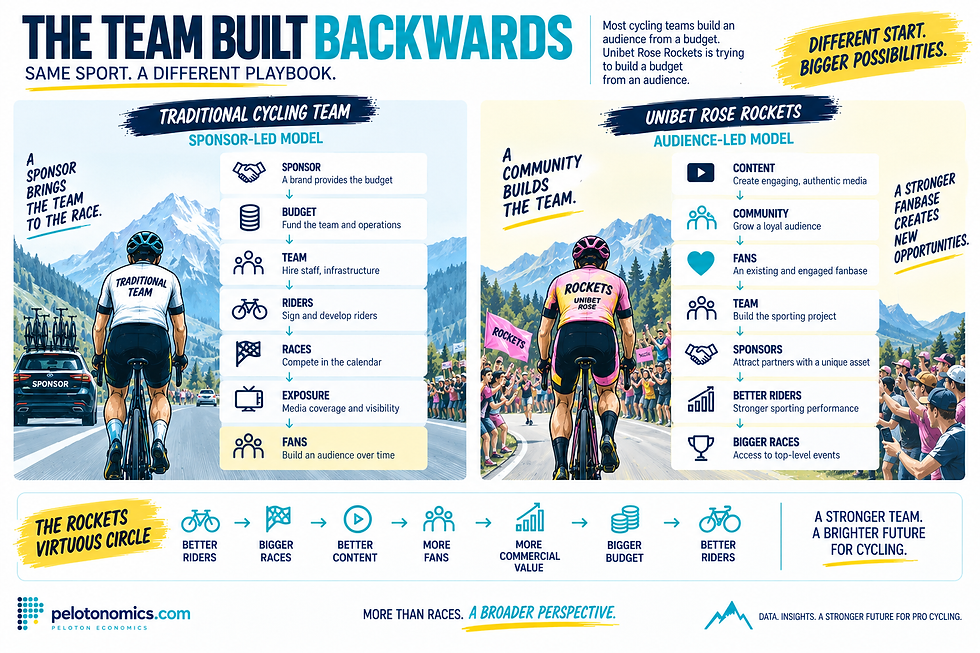
That sequence is more than an unusual origin story. It represents a fundamentally different approach to the economics of a cycling team. Traditional teams largely rent an audience from the events in which they participate. The Tour de France attracts millions of spectators and television viewers; teams bring their sponsors into that audience and receive exposure in return. Rockets is attempting to own a larger part of the relationship itself. Its races become raw material for content, content develops a community, that community creates measurable attention, and that attention becomes an asset the team can offer to commercial partners. Sporting performance remains essential, but it is no longer the only engine generating sponsor value. In simplified terms, the traditional model runs Sponsor → Budget → Team → Racing → Exposure → Fans. Rockets started much closer to Content → Community → Fans → Team → Sponsors → Better riders → Bigger races. That inversion is the first reason the project deserves to be viewed as something more significant than “the YouTube team.”
2. Bas Tietema: rider, creator and entrepreneur
The model is difficult to separate from the unusual profile of Bas Tietema. He is sometimes reduced to the role of YouTuber, but that misses what makes his position in professional cycling distinctive. Tietema came through the Dutch development system, rode for BMC Development Team and competed at professional level before his first career stalled. Tour de Tietema subsequently gave him a second route into cycling, this time from the media side. He therefore combines three profiles rarely found in one team founder: former elite rider, digital content creator and sports entrepreneur. That combination matters because he understood both the traditional peloton and the way younger audiences increasingly consume sport. Instead of trying to make cycling content look like conventional sports broadcasting, Tour de Tietema built much of its appeal around personality, humour, access and recurring characters. The founders themselves became part of the story.
That creator mentality has survived the transition into professional sport. Many cycling teams have excellent communications departments, but communication generally remains a support function serving the sporting organisation and its sponsors. Rockets has moved media much closer to the core product. In 2026 its dedicated YouTube channel passed 100,000 subscribers, while the organisation developed a workflow capable of producing race videos on the same day: footage can be transferred while racing is still underway, allowing editors to work before the riders have even returned from the finish. Around one particularly successful race weekend, its media operation reported more than 530,000 YouTube views across long-form and Shorts and around five million Instagram views. Those numbers need to be understood in context — social-media views are not equivalent to television audiences — but commercially they illustrate something important. A victory is no longer simply a result appearing on television for a few seconds. It can become a multi-day content asset distributed through channels controlled by the team itself.
3. From Tietema to Rockets: creating a team that can outlive its sponsors
Perhaps the most interesting strategic decision came when the organisation deliberately began removing its founder's name from the team's long-term identity. In 2025, TDT-Unibet evolved into Unibet Tietema Rockets and the organisation introduced “Rockets” as the permanent element of its brand. In 2026, with German bicycle manufacturer ROSE entering as bicycle supplier and naming partner under a four-year agreement, the team became Unibet Rose Rockets. Tietema disappeared from the name. Rockets did not. The change may appear cosmetic, but in the context of professional cycling it addresses one of the industry's most persistent structural weaknesses: teams rarely own a durable consumer brand. Sponsors come and go, names change, colours change and decades of sporting history can become difficult for casual fans to follow. The organisation behind a team may survive, while its public identity repeatedly starts again.
Rockets is attempting to separate those two layers. Rockets is the brand; Unibet and ROSE are commercial partners attached to it. It is not a franchise in the strict North American sports sense — there is no closed league granting permanent franchise rights — but it borrows an important element of franchise economics: a stable identity around which brand equity can accumulate. That potentially changes the value of sponsorship itself. A sponsor no longer needs to create the identity from scratch; it buys access to an existing team brand, story and community. If Unibet or ROSE eventually leaves, the strategic objective is that supporters continue following the Rockets. This is still an experiment rather than a proven model, and the team remains heavily dependent on sponsorship revenue. But the principle is significant: a cycling team becomes more valuable if some of its consumer recognition survives the companies currently paying for the jersey.
4. From followers to a commercial asset
This is where the Rockets model becomes particularly relevant to Pelotonomics. Having followers is not, by itself, a business model. The key question is whether an audience can be transformed into an asset that creates measurable value for the organisation. Rockets increasingly appears to be testing that transition. Its media channels provide direct distribution; fan events create physical engagement; merchandise can reinforce the permanent identity; and experiments around race-related content create touchpoints that do not depend entirely on broadcasters. At the 2026 Tour of Flanders, for example, the team combined its first participation with a Rockets fan zone on the Koppenberg in cooperation with Flanders Classics. It has also experimented with live digital race formats. The significance is less the absolute size of those initiatives than the direction of travel: viewer → follower → community member → identifiable fan → potential customer.
That progression addresses one of professional cycling's strangest commercial contradictions. The sport reaches enormous audiences, yet teams know surprisingly little about many of the people watching them. A spectator standing beside the Tour de France route may see twenty-two teams pass but establish no direct relationship with any of them. A television viewer is primarily a customer of the broadcaster. Social platforms give teams greater reach, but the platforms still control much of the underlying relationship and data. Rockets is trying to shorten that distance. The more fans deliberately choose to follow the team — rather than merely seeing it because they are watching the Tour — the more valuable the team itself can potentially become. This is also where the project connects directly with the logic behind Collective Cycling Group. CCG wants to aggregate the audiences, content and commercial rights of many teams into a collective asset. Rockets is already attempting the same transformation at micro level: turning audience ownership into team value.

5. The media project now needs sporting credibility
None of this works indefinitely without results. A disruptive media strategy may attract attention, but professional cycling ultimately allocates its most valuable inventory — the biggest races — primarily according to sporting status, rankings and organiser selection. The speed of the Rockets' sporting development is therefore almost as important as its audience growth. The team moved from Continental level in 2023 to ProTeam status in 2024. Its programme expanded from roughly 48 race days in 2023 to 115 in 2024 and 157 in 2025, according to ProCyclingStats. By 2026, the roster had changed significantly, bringing in riders with substantial WorldTour experience and winning pedigree. The project that could once be dismissed as a content experiment was increasingly competing as a serious professional racing organisation.
The 2026 calendar represents the clearest evidence of that transition. The Rockets secured invitations across events controlled by all three of cycling's major organiser groups, including races such as Strade Bianche, Milan-San Remo, the Tour of Flanders, Paris-Roubaix and the Ardennes Classics, while the Giro d'Italia became the team's first Grand Tour. The Tour de France remains the defining ambition. That is particularly symbolic because the project itself was born around the Tour, and the team has openly talked about ultimately racing — and winning — there. Yet the fact that the Rockets can build a large audience without possessing a Tour invitation also exposes the limits of disruption. They may own their brand and increasingly their fan relationship, but ASO still owns access to cycling's most valuable stage. Media credibility can accelerate the project; it cannot replace sporting credibility. The long-term challenge is to make the two reinforce each other.
6. Can fan engagement become a competitive advantage?
That convergence may already be visible in recruitment. A young ProTeam attracting riders with significant WorldTour experience would traditionally need to compensate for its lower sporting status primarily through salary or leadership opportunities. Rockets can potentially offer something else: visibility, personality and a highly engaged audience. For a rider, being part of a team producing regular long-form content and building stories around its athletes can create an individual platform that a more successful but less media-oriented organisation may not offer to the same extent. That does not mean riders will accept substantially lower salaries simply for YouTube exposure, nor that media reach can replace performance infrastructure. But when financial and sporting propositions are reasonably close, fan engagement could become another variable in the rider market.
More importantly, the mechanism can become circular. Better riders increase the probability of victories and invitations to bigger races. Bigger races create better content. Better content attracts more fans. A larger audience creates more value for sponsors. Greater commercial value supports a larger budget, which makes better riders easier to recruit. This is the potential Rockets flywheel. The model is still young and therefore unproven over a full sponsorship cycle, but it is fundamentally different from relying exclusively on the traditional equation of more budget → better riders → better results → more television exposure. Rockets adds an owned-media layer between sporting performance and commercial return. If that layer becomes sufficiently valuable, it could partially decouple sponsor ROI from results — one of the most difficult problems for smaller professional teams.
7. What if the Rockets model works?
The most important question is therefore not whether Unibet Rose Rockets eventually reaches the Tour de France. It is what happens elsewhere in professional cycling if the underlying model proves sustainable. Almost every WorldTour team now produces social content, but many remain fundamentally sports organisations with media departments. Rockets is moving towards something different: sports team + media company + fan platform + permanent brand. That distinction could force competitors to reconsider what they actually own. Permanent team identities, first-party fan databases, creator-style storytelling, faster race content, fan events and merchandise linked to the team rather than exclusively to sponsors could all become more strategically important. The consequences may also extend to race organisers. Teams that build their own audiences become more valuable participants in an event because they bring distribution and fan relationships with them rather than relying entirely on the organiser to provide both.
There is an obvious danger in overstating the case. Rockets still needs sponsors. It still needs invitations. It still needs results. It does not own the races that provide much of its most valuable content, and its current growth has taken place during a period of rapid sporting investment that needs to prove financially sustainable. But that is precisely what makes the experiment interesting. The Rockets are not replacing the traditional cycling model; they are adding assets that traditional teams historically failed to build. Tour de Tietema created the audience before the team existed. Rockets created a permanent identity before reaching cycling's highest level. The professional organisation is now trying to convert those assets into sponsorship value, sporting performance and eventually access to the Tour de France. If it succeeds, the lesson for the rest of the peloton will be much bigger than how to make better YouTube videos. It will suggest that the future value of a professional cycling team may depend not only on the races it wins or the sponsors it attracts, but on how much of its own brand, audience and commercial relationship with the fan it actually owns.


Comments